

Measure your room’s length and width, then multiply to find square footage. Small rooms under 144 square feet need 36–42 inch fans. Medium rooms between 144–225 square feet require 44–50 inch blades. Large rooms over 225 square feet demand 52–72 inch spans. Blade size creates airflow patterns across your space; undersizing leaves dead zones while oversizing wastes energy. Proper sizing prevents costly mistakes and allows your fan to perform efficiently. Understanding ceiling height and mounting type will help refine your selection for lasting results.
Measure Your Living Room for the Right Fan Size

How do you know which ceiling fan size will actually work in your space? Start by measuring your living room’s length and width in feet, then multiply them together to find your square feet. This calculation defines which blade span you’ll need.
A 12×12 room equals 144 square feet, requiring a 36–42 inch fan. A 14×16 room totals 224 square feet, calling for 44–52 inch options. The blade span creates airflow patterns because larger blades cover more area efficiently.
High ceilings demand a downrod to position blades at 8–9 feet, where they perform optimally. The downrod does this job because it extends the fan away from the ceiling structure. Taking these measurements first prevents costly mistakes and guarantees your chosen fan actually fits your space.
Calculate the Ideal Fan Size by Square Footage

Once you’ve measured your living room’s length and width, multiply those numbers together to determine your square footage. This calculation creates the foundation for matching your space to the right blade span, since larger rooms need bigger fans to circulate air effectively. Your ceiling height also defines fan performance, because lower ceilings may require adjustments to standard sizing recommendations.
Measure Room Square Footage
The first step toward choosing the right ceiling fan involves measuring your room’s actual dimensions. You’ll multiply your room’s length by its width to determine total square footage. This measurement defines which fan size works best for your space.
| Room Size | Square Footage | Recommended Fan Blade Span |
|---|---|---|
| Small | Up to 75 sq ft | 29–36 inches |
| Medium | 75–175 sq ft | 42–48 inches |
| Large | 175–350 sq ft | 52–56 inches |
| Extra Large | 350+ sq ft | 60+ inches or multiple fans |
A 144 square-foot room typically needs a 36–42 inch fan because moderate coverage matches these dimensions. Larger spaces of 224 square feet align with 44–52 inch options. The ceiling fan sizing formula creates proper air circulation when you match blade span to room size. Accurate measurements help you select equipment that delivers comfort without oversizing or undersizing your investment.
Match Size To Space
Why does matching your fan’s blade span to your room’s square footage matter so much? Your ceiling fan size directly defines how well it circulates air throughout your space. The blade span creates airflow patterns that either reach every corner or leave dead zones.
For rooms up to 75 square feet, choose a 29–36 inch blade span. This smaller fan handles compact spaces without overwhelming them. Rooms between 75–175 square feet need 42–48 inch fans for balanced coverage. Larger areas from 175–350 square feet require 52–56 inch blade spans to move air effectively.
Spaces exceeding 350 square feet demand 60 inch fans or multiple units. Room square footage serves as your starting calculation, though ceiling height and openness refine your final decision.
Account For Ceiling Height
How high is your ceiling?
Ceiling height determines which mounting option works best for your space. For ceilings under 8 feet, opt for a flush-mount or low-profile fan to maintain blade clearance and headroom. These designs keep the fan close to the ceiling, preventing head bumps in compact rooms.
If your ceiling measures 8–9 feet, standard downrod mounting positions blades at the right height for efficient airflow. The downrod extends the fan lower, creating better air circulation throughout your living room.
Ceilings higher than 9 feet benefit from a longer downrod. This accessory brings blades down to the 8–9 foot range, where air movement performs most effectively. The downrod solves the problem of mounting fans too high, which reduces their cooling and circulation capabilities. Remember: proper hanging height matters as much as fan size itself.
Small Living Rooms (Under 144 Square Feet): Pick 36–42 Inch Fans

In small living rooms under 144 square feet, a 36–42 inch fan maintains balanced visual weight without dominating your furniture or walls. Your 36–42 inch choice delivers even airflow coverage across the entire space because the larger blade span compensates for the room’s compact dimensions. This size range provides proper proportion—substantial enough to circulate air effectively, yet appropriately scaled to maintain sightlines and comfortable clearance from occupants.
Visual Weight And Proportion
When you’re furnishing a small living room under 144 square feet, your ceiling fan’s size directly shapes how crowded or balanced the space feels. A 36–42 inch ceiling fan creates visual weight that matches your room’s proportions without overwhelming it.
Consider these design principles:
- Compact fans preserve ceiling space, allowing your eyes to move freely across the room
- Oversized fans dominate the ceiling and make furniture appear smaller by comparison
- Properly scaled fans establish proportional balance between all room elements
- Mismatched sizes create tension that disrupts the space’s calm atmosphere
The fan’s blade span does this because it determines how much visual attention the ceiling demands. A 42-inch fan in your small room maintains uncluttered sightlines while delivering adequate airflow. Match finishes like matte bronze or brushed nickel to existing hardware. This approach defines comfort through restraint.
Airflow Coverage Efficiency
Choosing the right blade span determines whether your fan circulates air efficiently or creates dead zones across your seating areas. For rooms under 144 square feet, a 36–42 inch blade span delivers the airflow coverage you need without overwhelming compact layouts.
A 42-inch fan creates broad air distribution across standard 8-foot ceilings, reaching furniture arrangements near walls and corners. The blade span defines how far air travels throughout your room size. Smaller 36–38 inch options work better in very tight spaces because they prevent excessive airflow that feels uncomfortable.
The fan’s diameter directly affects circulation patterns because larger blades push air farther. Your room’s proportions and ceiling height determine which blade span provides optimal coverage. This balance maintains consistent temperature regulation throughout your living area without visual heaviness.
Medium Living Rooms (144–225 Square Feet): Pick 44–50 Inch Fans
What size fan works best for a medium living room?
For spaces between 144–225 square feet, you’ll want a ceiling fan with a 44–50 inch blade span. This size range creates balanced air coverage without overwhelming your room visually. Here’s what you should consider:
- A 44–50 inch fan maintains ideal blade clearance when your ceiling sits around 8–9 feet high
- The blade span provides even circulation across seating areas, especially in open layouts
- Multiple speed settings let you adjust airflow based on seasonal needs
- An optional light kit reduces the need for additional fixtures
The blade span performs this job effectively because it distributes air evenly throughout your space. Standard downrod mounting in this range defines proper airflow patterns. You’re choosing equipment that solves your room’s specific sizing challenge.
Large Living Rooms (Over 225 Square Feet): Pick 52–72 Inch Fans
For living rooms exceeding 225 square feet, you’ll need a ceiling fan with a 52–72 inch blade span. This ceiling fan size creates efficient airflow across expansive layouts without creating dead zones where air stagnates. A 52–54 inch fan works well for spaces just over 225 square feet, while 60–72 inch models suit larger, open-concept rooms. The blade span defines how effectively your fan circulates air because wider blades reach farther distances. Higher ceilings pair well with downrod-mounted fans positioned 8–9 feet above the floor, maximizing airflow effectiveness. Multiple fans or one large fan provides even circulation throughout your space. Modern DC fans or industrial-style models deliver reliable performance for large living rooms while maintaining balanced air movement across the entire area.
Does Ceiling Height Change Your Fan Size Choice?

How much space sits between your ceiling and floor? This measurement defines your entire fan selection strategy. Ceiling height directly changes your downrod length needs and blade height positioning.
Ceiling height fundamentally determines your fan selection strategy, directly influencing downrod length and blade positioning requirements.
Consider these four factors:
- Low ceilings (under 8 ft) require flush-mount fans to keep blades safely above 7 ft
- Standard 8 ft ceilings work best with smaller fans without downrods
- High ceilings (9–10 ft) need downrods to lower blades into the optimal 8–9 ft range
- Very tall spaces allow larger 50–56 inch fans when properly suspended
The downrod length does the heavy lifting because it positions your blades at effective operating heights. Calculate your downrod by subtracting 9 feet from your total ceiling height. This creates proper airflow and safety simultaneously. Your ceiling height directly shapes which fan investment makes sense for your living room.
Airflow Patterns: How Room Layout Affects Fan Size Needs

Your room’s shape and furniture arrangement directly define how large a fan you’ll need for proper air movement. Open living rooms with central seating benefit from 52–60 inch blades because they distribute air across the middle zone and toward the edges effectively. Square rooms typically work well with 42–54 inch fans positioned centrally, while long rectangular spaces often require larger fans or multiple units to reach all seating areas evenly.
Central Placement and Coverage
Where you position your ceiling fan fundamentally shapes how air circulates throughout your living room. Central placement creates even airflow coverage that reaches every corner and seating zone efficiently.
Your ceiling fan size and placement work together to define comfort:
- A centered fan in square rooms eliminates dead zones where stagnant air collects
- Mounting near the center reduces reliance on your HVAC system, lowering energy costs
- Proper airflow reaches distant seating areas, so everyone feels the same breeze
- Strategic positioning prevents hot and cold spots that frustrate household members
The fan distributes air evenly because its centered location minimizes obstructions. Keep your fan at least 18 inches from walls—this distance prevents airflow disruption. For rectangular rooms, consider larger 50–54 inch blade spans to push air across the entire space effectively. Central placement solves the fundamental challenge: getting consistent comfort throughout your living room.
Shape-Specific Airflow Distribution
Does your living room’s layout match a perfect square, or does it stretch long and narrow? Your room shape directly defines the blade span you’ll need for effective airflow distribution. Square rooms work well with centered, mid-size fans around 42–54 inches because balanced layouts naturally support even cooling. Rectangular spaces, however, create challenges. They’re longer than they’re wide, which means air doesn’t reach distant corners effectively. You’ll want larger fans spanning 50–56 inches, or consider installing two smaller units instead. Irregular room shapes with architectural features like beams or soffits generate dead zones where air stagnates. Strategic fan placement addresses this problem by directing airflow toward seating areas. Understanding how your specific room shape interacts with airflow patterns helps you choose the right fan size for genuine comfort.
Pick the Right Mount Type for Your Ceiling

How you mount your ceiling fan directly shapes both safety and performance in your living room.
Your mounting choice creates proper clearance and defines how effectively your fan circulates air throughout the space. Consider these four mounting options:
- Flush-mount fans sit closest to the ceiling, maximizing headroom on 8-foot ceilings
- Standard downrod mounting positions blades 8–9 feet above the floor, balancing airflow with safety
- Vaulted ceiling installations use longer downrods to maintain blade clearance on sloped surfaces
- Sloped ceiling adapters maintain proper blade distance from angled surfaces
The downrod mounting works because it creates adequate space between spinning blades and your head. Flush-mount fans work well because they eliminate dangling hardware in compact rooms. Vaulted ceiling installations function properly because longer rods compensate for height variations. Align your mount choice with your ceiling height and room layout for optimal results.
Set Downrod Length and Verify Blade Clearance

Once you’ve selected your mounting type, the downrod length becomes your next control point for performance. The downrod length directly affects where your fan blades sit relative to your ceiling height. For standard 8–9 foot ceilings, you’ll typically use a 2–6 inch downrod. However, taller ceilings require longer rods—simply subtract 9 feet from your ceiling height to find the needed length. A 12-foot ceiling, for example, needs a 3-foot downrod.
Blade clearance matters equally. Maintain 8–12 inches between blades and ceiling to minimize recirculation and allow proper airflow. The space does this work because adequate distance allows air to move freely downward. Sloped ceilings demand special attention—you may need additional length to maintain optimal blade positioning. This adjustment preserves balance and performance despite uneven surfaces.
Match Fan Size to Room Style Without Sacrificing Performance
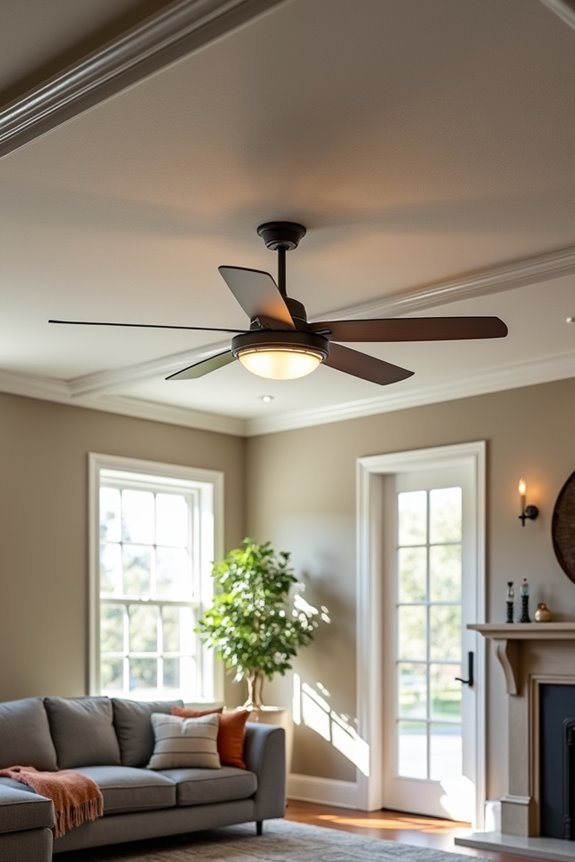
Your ceiling fan’s size and style work together to define your living room’s visual balance and airflow distribution. The right ceiling fan size matches your room size while complementing your décor choices.
- Small rooms (up to 144 sq ft) need 36–42 inch fans for balanced proportions and adequate airflow
- Standard to large rooms (144–225 sq ft) require 44–52 inch fans to maintain visual weight and even air circulation
- Very large rooms (225–400 sq ft) benefit from 50–54 inch fans or dual units for ideal coverage
- High ceilings need 52–60 inch downrod-mounted fans to preserve performance without overwhelming the space
Select finishes that complement your furnishings. Dark blades pair beautifully with wood furniture for rustic appeal. White or brushed nickel creates clean lines for modern spaces. This approach guarantees your airflow distribution matches both your aesthetic preferences and your room’s functional needs.
When Two Small Fans Outperform One Large Fan

Two small fans outperform one large fan in larger rooms exceeding 225 square feet because they create more uniform airflow across the entire space. In long or open-layout living rooms, strategic positioning of two small fans defines balanced circulation around seating areas and transitions. The fans do this because they eliminate dead zones that a single oversized unit might miss. Two small fans also offer flexible placement around furniture and obstructions. When ceiling height is limited, compact fans maintain proper blade clearance without dominating your room visually. Your room layout ultimately determines whether two smaller fans better serve your needs than one large alternative.
Avoid These Common Living Room Sizing Mistakes

How often do homeowners choose a ceiling fan based solely on ceiling height? This common mistake overlooks room square footage entirely, creating poor airflow balance throughout your space.
Homeowners often overlook room square footage when selecting ceiling fans, focusing solely on ceiling height and creating poor airflow balance.
Sizing mistakes compound when you ignore these critical factors:
- Selecting fans under 44″ for rooms exceeding 144 sq ft, leaving dead zones without proper circulation
- Choosing oversized fans for compact spaces, which overwhelms rooms and wastes energy needlessly
- Installing flush mounts on high ceilings instead of proper downrods, restricting airflow effectiveness
- Assuming one fan handles open-plan layouts, neglecting multiple-fan placement strategies
The rule matters because rooms measuring 175–350 sq ft typically need 52″–56″ fans specifically. Undersizing or oversizing directly impacts your comfort level for months ahead. Your room dimensions, not ceiling height alone, determine optimal fan selection and installation success.
Select Controls, Efficiency, and Finalize Your Choice

Once you’ve selected the right fan size and style, your control system becomes the deciding factor in daily usability and long-term satisfaction. Your ceiling fan sizing choice deserves equally thoughtful control options that match your lifestyle.
Pull chains suit infrequent adjustments, while wall controls minimize clutter. Handheld remotes offer convenience for dimming and speed changes. Smart home integration creates an efficient experience through scheduling and voice commands that define your energy consumption patterns.
DC motors paired with remote controls enable precise speed adjustments that reduce power use substantially. The dimming capability does more than set ambiance because it directly lowers electricity demands during evening hours.
Verify compatibility with your mounting type and ceiling height before finalizing. This complete ceiling fan sizing approach delivers lasting satisfaction and operational efficiency.