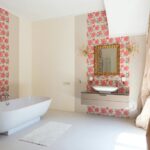
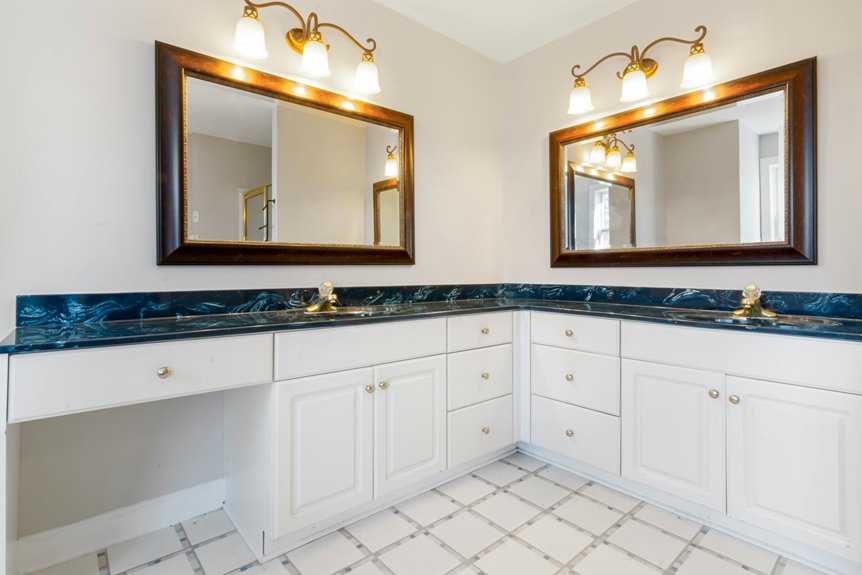
A bathroom vanity combines your sink, storage, and countertop into one functional unit that defines your bathroom’s style while solving storage challenges.
You’ll choose from widths ranging 24 to 84 inches to fit your layout.
Your decision involves selecting materials like quartz or granite for durability, picking sink styles such as undermount or vessel, and matching finishes to your home’s design.
Measure your space carefully, account for plumbing locations, and consider whether custom or prefab options serve your timeline and budget best.
Understanding these components helps you create a vanity that works for your daily routine.
What Is a Bathroom Vanity (And Why You Care)
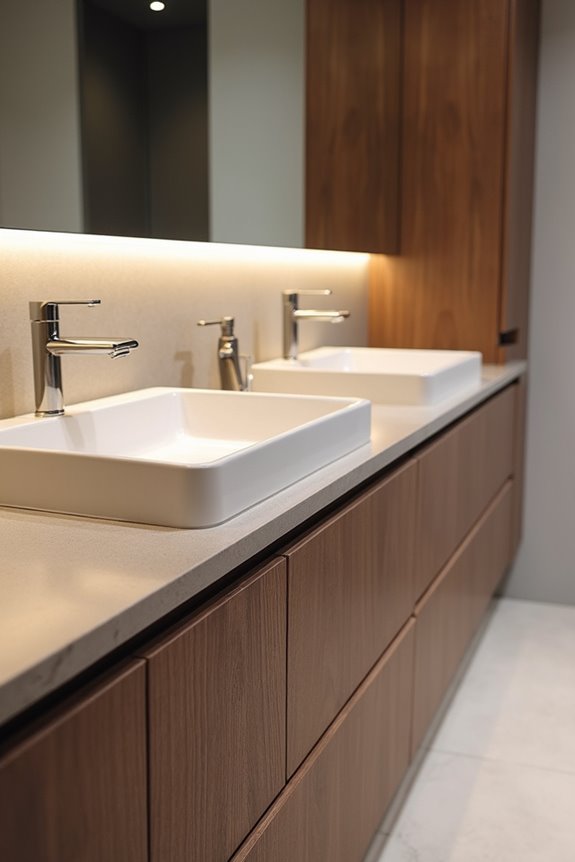
What’s taking up most of the space under your bathroom sink? That’s your vanity—the essential furniture piece combining a sink, storage, and countertop into one functional unit.
Your vanity creates the primary workspace where you brush your teeth, wash your hands, and organize daily essentials. It defines your bathroom’s style while solving storage challenges. Vanities come in sizes from 24 to 84 inches wide, so you’ll find options fitting any layout.
Your vanity is your bathroom’s command center—a functional workspace that organizes essentials while defining your style and fitting any layout.
The countertop serves dual purposes: it provides workspace and protects the cabinet below. Material choices like quartz, granite, and laminate affect durability and appearance. Sink styles—drop-in, undermount, or vessel—influence how much counter space you actually have.
Vanity bodies use hardwood, engineered wood, or laminate. These materials determine longevity and maintenance needs. Selecting the right vanity makes your bathroom more organized and functional.
Measure Your Space and Plan the Layout
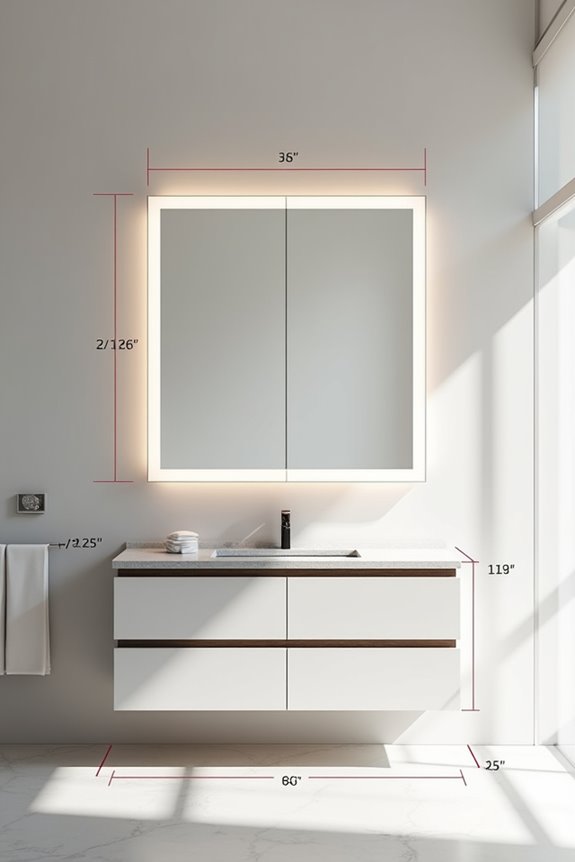
Now that you’ve identified what a vanity is and why it matters, you’ll need to measure your space carefully before selecting one. Start by recording your bathroom’s width, depth, and height. Account for door swings and walkways to maintain clear traffic flow. Check existing plumbing locations and wall positions, since they define whether you need a standard or custom vanity.
| Measurement | Purpose |
|---|---|
| Width & Depth | Determines vanity size |
| Door Swing Space | Prevents obstruction |
| Plumbing Locations | Guides placement options |
| Clearance to Toilet | Maintains code compliance |
Position your vanity to avoid conflicts with mirrors, outlets, and switches. Allow at least 18 inches from the cabinet edge to the toilet’s center for comfortable movement. This vanity layout creates efficient space planning while supporting practical functionality.
Custom vs. Prefab: What Fits Your Timeline and Budget
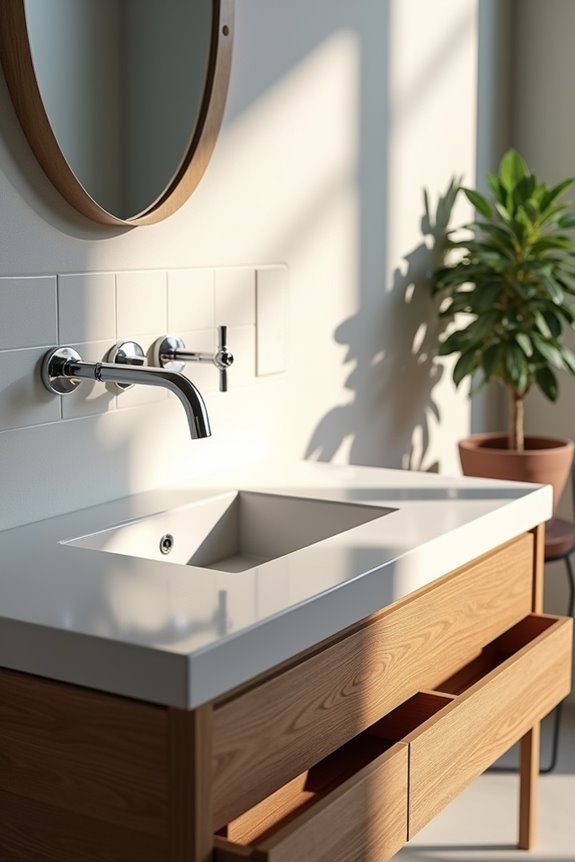
Have you considered how much time and money you’re willing to invest in your bathroom vanity? Your choice between custom and prefab options directly shapes your budget and timeline.
Prefab vanities cost less and install quickly because manufacturers produce them in standard dimensions with preset finishes. You’ll find limited color and material choices, yet they address immediate needs at lower cost.
Custom vanities create tailored solutions matching your exact space and plumbing requirements. These options let you define your design vision through unlimited finishes and precise component integration—sinks, countertops, backsplash, and hardware work together cohesively. However, custom builds require higher investment and longer wait times.
The prefab vanity appeals to tight budgets because manufacturers optimize production. The custom vanity appeals to specific spaces because craftspeople design each element precisely. Weigh your financial capacity, installation urgency, and need for exact fit against available features.
Decide Between Freestanding, Wall, or Floating Vanities
Your bathroom’s layout and design aesthetic determine which vanity style works best for your space. Freestanding vanities offer classic design and built-in storage, making them suitable for small to medium bathrooms. Wall-mounted and floating vanities float off the floor, creating a spacious feel that defines modern bathrooms. They’re ideal when you need easier cleaning underneath. Floating vanities work especially well in tight layouts because they maximize floor space. Consider your plumbing location carefully. Corner vanities solve congested bathrooms by placing the sink in a corner, freeing central floor space for movement. Double-sink configurations require careful measurement to account for adequate storage and counter space for shared use. Evaluate weight-bearing support and how each mounting style impacts accessibility and maintenance before deciding on your bathroom layout.
Plan Storage: What Your Vanity Needs to Hold
Before you choose your vanity, you’ll need to inventory what you’re actually storing—toiletries, towels, cleaners, and daily essentials—because this list directly defines whether drawers, cabinets, or open shelving works best for your space. Your bathroom’s size matters here: smaller rooms require you to balance counter accessibility with storage capacity, while larger bathrooms let you incorporate multiple drawers or integrated shelving without limitation. This planning step creates a vanity that functions properly because you’ve matched storage type to what you’ll actually keep inside.
Storage Needs By Room
How much storage does your bathroom vanity actually need? The answer depends entirely on your room’s function. Master bathrooms benefit from ample drawers and cabinets since you’re storing daily essentials like makeup, brushes, and cosmetics. Powder rooms require less vanity storage because guests use them briefly. Drawers organize small items effectively through separation, while cabinets hold bulkier towels and cleaning supplies. Guest bathrooms need moderate storage that doesn’t overwhelm limited space. Kids’ bathrooms demand accessible drawers at lower heights. Integrated storage solutions like pull-out trays maximize bathroom organization without cluttering countertops. Your room function defines the vanity configuration—single or double sink—and the balance between countertop space and storage capacity. This strategic approach creates functional vanity storage that matches your lifestyle.
Drawer and Cabinet Organization
What separates a cluttered bathroom counter from an organized one? Smart drawer and cabinet organization. You’ll want to consider these storage solutions:
- Drawer organizers and soft-close hardware reduce slamming while keeping contents tidy
- Cabinet doors swing open to reveal larger storage spaces for bulk items
- Pullout shelves provide easy access to hair tools and cosmetics
- Integrated shelving beneath the countertop eliminates counter clutter
Drawers offer outward extension for small items, while cabinet doors create space for larger supplies. This mix optimizes both organization and capacity. The soft-close hardware does more than quiet your morning routine—it protects your vanity’s longevity.
Plan your storage by mapping exact items you’ll keep: toiletries, towels, cleaners. Allocate spaces accordingly across drawers and cabinets. This approach fits current needs while anticipating future use, defining a functional bathroom that works for you.
Choose a Sink Type for Your Vanity
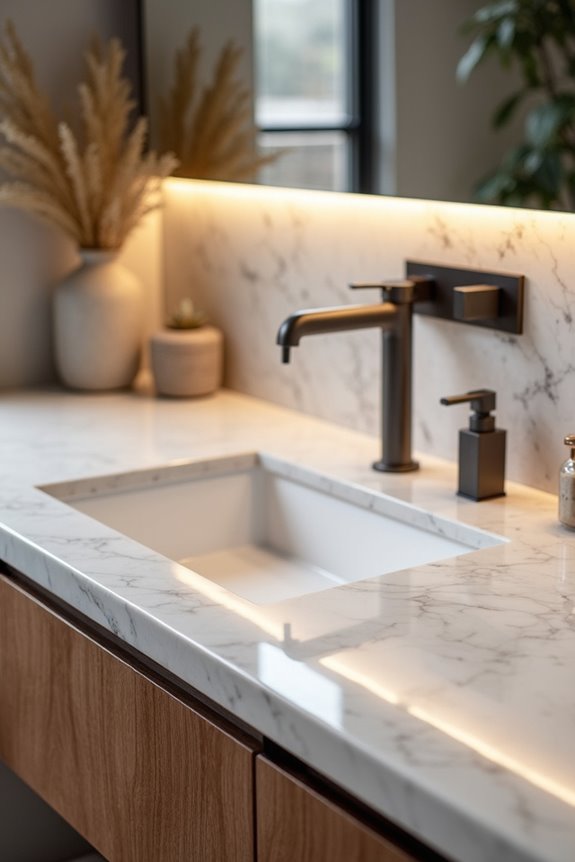
You’ll encounter two primary sink installation methods that fundamentally shape your bathroom’s functionality and appearance. Vessel sinks sit atop your counter, creating a visual focal point but reducing your usable counter space for daily items. Undermount sinks install beneath the countertop surface, which provides a streamlined look and makes wiping debris directly into the basin easier than with drop-in models.
Sink Installation Methods
Selecting a sink type fundamentally shapes how your vanity functions and looks. You’ll find several installation methods that suit different spaces and preferences:
- Undermount sinks mount beneath the counter, creating a seamless surface that maximizes cleaning space and requires sturdy countertop material.
- Drop-in sinks sit on the surface with visible rims, offering versatility and easy installation across most materials.
- Vessel sinks sit entirely atop counters, adding visual interest while potentially reducing available toiletry space.
- Wall-mounted options pair with specific faucet configurations, defining bathroom aesthetics.
Each method demands countertop compatibility and proper faucet predrill configurations. Drop-in edges collect moisture without sealing. Undermount installations need precise mounting. Vessel designs become focal points. Your vanity’s layout determines which installation method works best for function and clearance.
Vessel Versus Undermount
Choosing between vessel and undermount sinks shapes your bathroom’s look and functionality. Each style defines how you’ll use your vanity daily.
| Feature | Vessel Sinks | Undermount Sinks |
|---|---|---|
| Countertop Space | Requires more area | Preserves counter room |
| Edge Exposure | Visible rim | Seamless edge |
| Faucet Pairing | Bold statement pairings | Integrated appearance |
Vessel sinks sit atop countertops, creating a focal point but consuming valuable countertop space. They require substantial materials like granite to support their weight. Undermount sinks mount beneath counters, offering sleeker aesthetics and easier cleaning.
Edge exposure differs markedly. Vessel designs showcase decorative rims; undermounts eliminate visible edges. Your faucet pairing choices vary accordingly. Vessel arrangements allow dramatic fixture statements, while undermounts blend fixtures fluidly.
Storage and plumbing layout matters too. Vessel installations reduce under-sink clearance, whereas undermounts align naturally with standard cabinet configurations. Consider which arrangement matches your bathroom’s storage needs.
Select Durable Countertop Materials
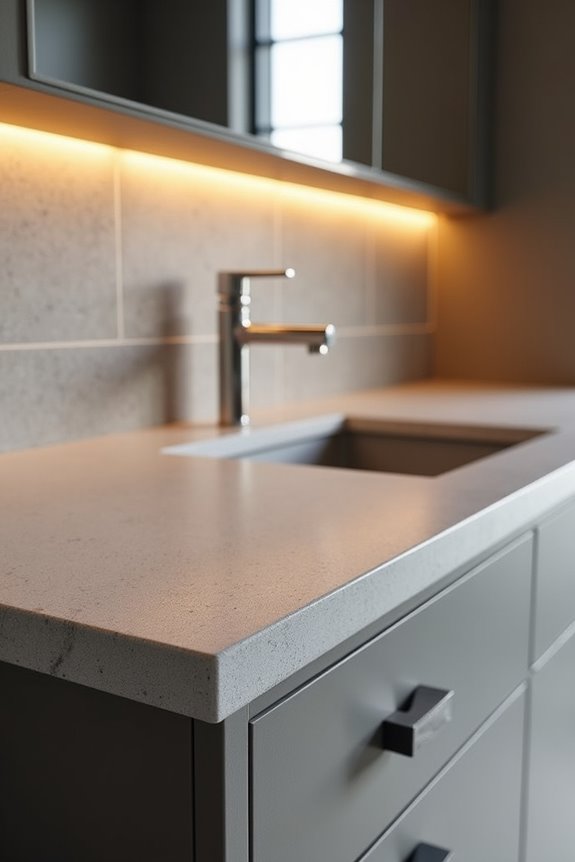
What makes a countertop last in a bathroom’s wet environment? You’ll want materials that resist moisture and staining while maintaining their appearance. Several options create durable surfaces for your vanity:
- Quartz countertops offer non-porous surfaces that resist moisture and stains without requiring sealing.
- Stone countertops like marble or granite need periodic sealing to maintain water resistance and prevent etching.
- Solid surface materials such as Corian provide seamless, non-porous finishes that resist moisture easily.
- Porcelain or sintered materials like Dekton resist scratches, heat, and chemicals effectively.
Laminate countertops remain economical but lack the scratch and heat resistance of stone options. Your choice defines how much maintenance your countertop demands. Quartz countertops and solid surface materials create lower-maintenance solutions, while stone countertops require more care. Each option addresses different priorities regarding durability and upkeep.
Match the Style and Finish to Your Bathroom Design
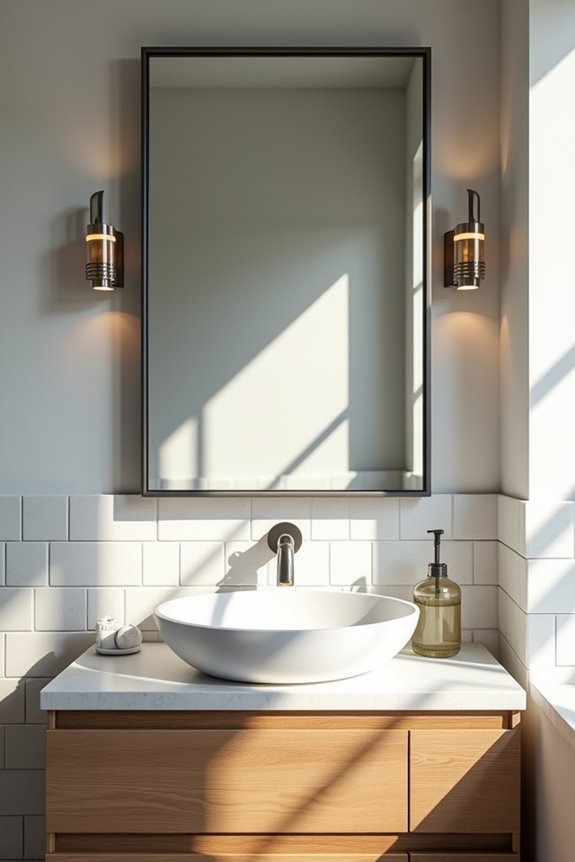
Your vanity’s style sets the visual tone for your entire bathroom. Matching your vanity’s finishes to existing elements creates a unified look that works well together.
Select a vanity style—traditional, transitional, or contemporary—that aligns with your home’s architecture. The style you choose defines how hardware, wood tones, and metal finishes work together. Coordinate finishes across vanity, mirrors, faucets, and cabinetry by selecting matching knob styles and metal finishes like chrome, nickel, brass, or bronze.
| Style | Best For | Metal Finish | Wood Tone | Hardware |
|---|---|---|---|---|
| Traditional | Classic homes | Brass/bronze | Dark cherry | Ornate knobs |
| Transitional | Mixed aesthetics | Nickel/chrome | Medium oak | Simple pulls |
| Contemporary | Modern spaces | Chrome/matte | Light ash | Minimalist handles |
| Shaker | Farmhouse designs | Oil-rubbed bronze | Natural wood | Cup pulls |
| Rustic | Cottage style | Aged bronze | Reclaimed wood | Wrought iron |
Integrate complementary tile, flooring, and countertop colors so your vanity’s surface connects visually with your broader bathroom palette.
Choose Vanity Hardware and Finishes
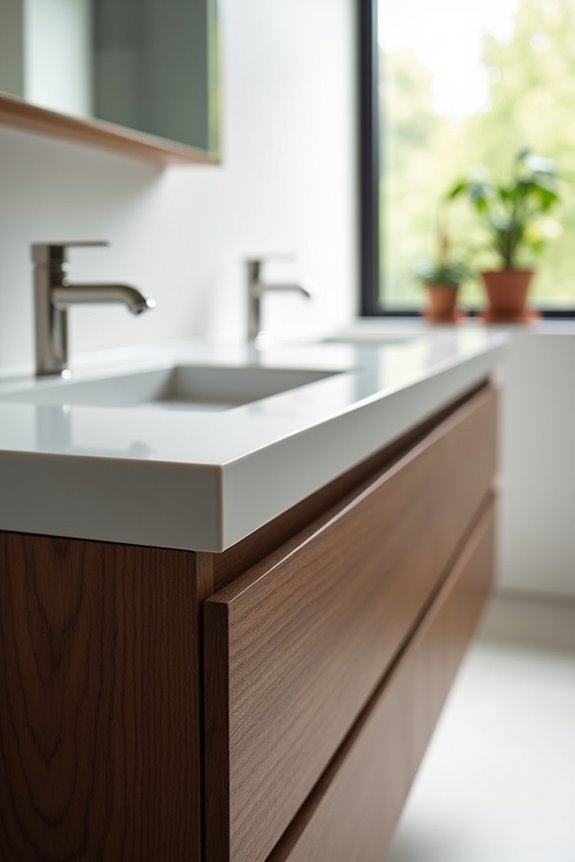
The hardware and finishes you select work together to define your vanity’s overall character and functionality. Your choices create a unified look that belongs in your bathroom space.
Consider these vanity hardware options:
Polished chrome, brushed nickel, black bronze, and brass finishes each bring distinct character to your bathroom vanity design.
- Polished chrome and brushed nickel for modern, clean aesthetics
- Black and bronze finishes for darker, sophisticated styles
- Brass tones that coordinate with warm décor elements
- Soft-close hardware that enhances durability and usability
Match your faucet compatibility by confirming predrilled holes align with centerset or widespread configurations. Integrated outlets hidden in drawers add convenience without disrupting your design. The unified design you’re building requires finishes that harmonize with your vanity style, top material, and surrounding bathroom elements. This attention to detail makes your vanity a functional and intentional part of your bathroom design.