
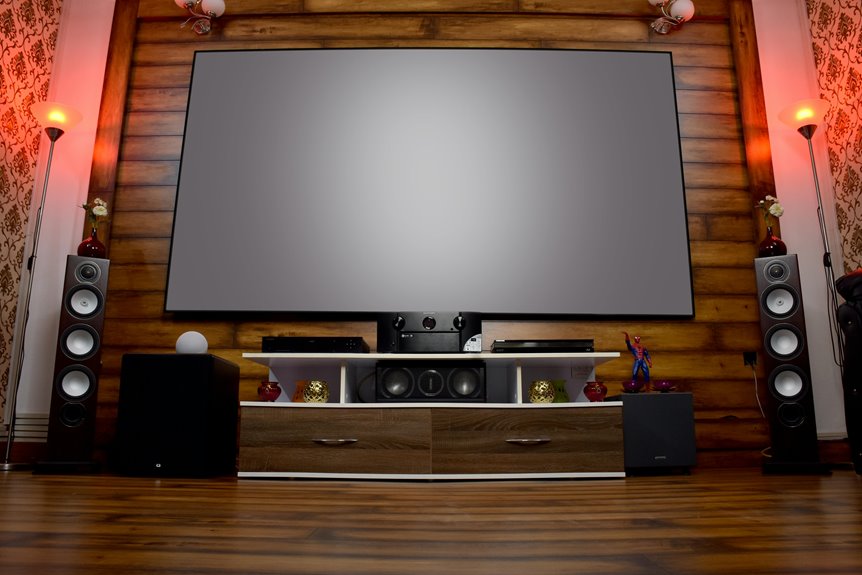
Your subwoofer’s placement affects bass quality far more than the equipment itself. Start with the subwoofer crawl—position it at your listening spot, then move around your room with bass-heavy music to find where it sounds fullest.
Front-wall placement blends bass with your main speakers and reduces timing delays. Avoid parallel walls, which generate standing waves and bass cancellations.
Consider two subwoofers positioned diagonally opposite to smooth bass throughout your entire room. Each placement strategy solves specific acoustic problems through strategic positioning.
How Subwoofer Placement Affects Bass in Your Room
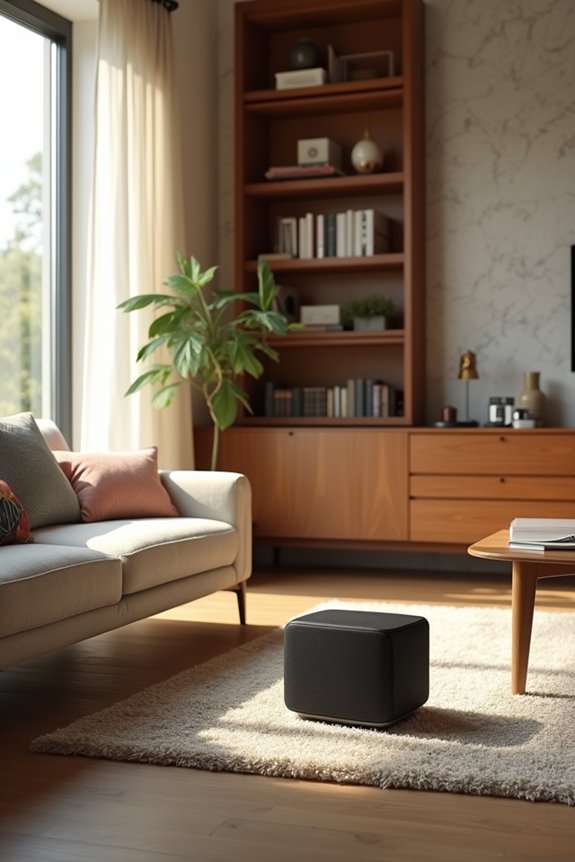
Where you place your subwoofer fundamentally shapes how bass sounds throughout your living room. Your subwoofer placement creates standing waves and room modes that either enhance or diminish bass response. The listening position interacts directly with subwoofer location, meaning strong bass in one chair becomes weak in another.
Front-wall placement improves frequency response by blending bass with your main speakers and reducing timing delays. Corner placement amplifies perceived bass energy but introduces more peaks and dips in room acoustics. Moving your subwoofer just inches changes where bass peaks and nulls occur, smoothing overall response.
Calibration is necessary because room dimensions create natural peaks and dips. Understanding these room acoustics principles helps you achieve balanced bass that works across your entire seating area, not just one spot.
Use the Subwoofer Crawl to Pinpoint Your Sweet Spot
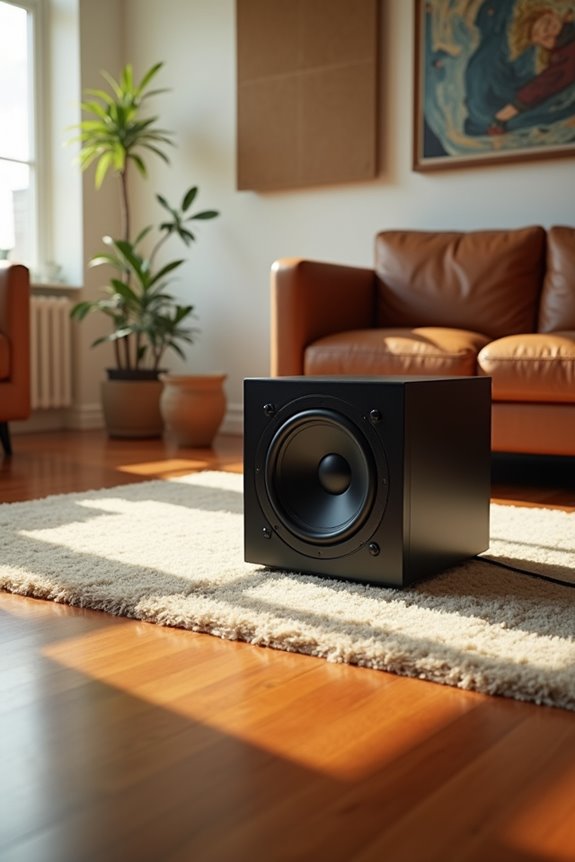
Theory alone won’t reveal where your subwoofer truly performs best in your specific room. The subwoofer crawl creates a systematic method for identifying your sweet spot by testing actual bass response across different locations.
Place your subwoofer at your listening position first, then move around the room while playing a familiar soundtrack with strong low-end content. Listen carefully for where bass sounds fullest and most balanced throughout your seating area. Mark promising spots with tape markers at floor level for easy reference.
Return to your listening position and compare the marked locations. This comparison defines which room placement delivers the best bass balance for your setup. The crawl works because it accounts for how your specific room’s dimensions affect bass response, making theory practical and actionable.
Choose Between Front Wall or Corner Placement
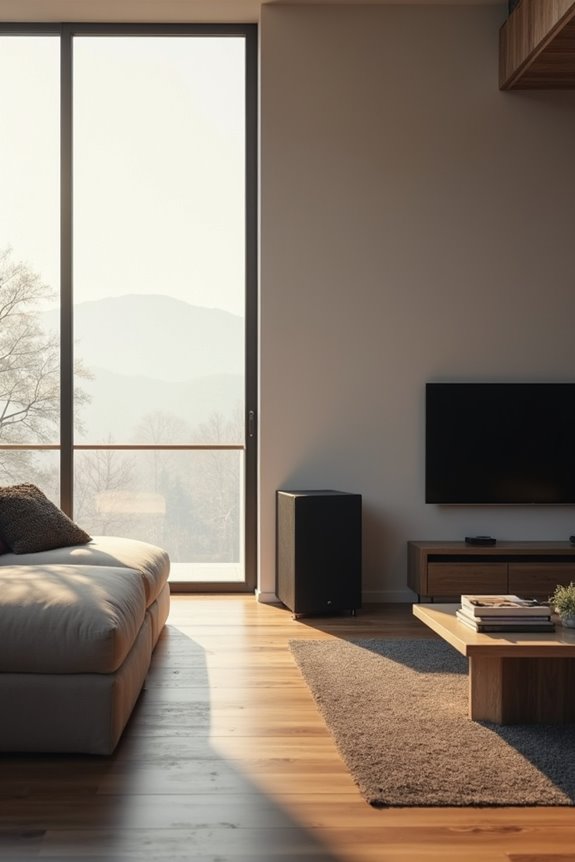
Once you’ve identified promising locations through the subwoofer crawl, you’ll need to decide between front wall and corner placement—two fundamentally different approaches that create distinct bass characteristics in your room. Front wall placement helps your subwoofer blend with main speakers while reducing localization issues. Keeping the sub a few inches away from the wall improves overall performance. Corner placement, however, excites room modes and increases perceived bass energy, though it often creates peaks and dips in your bass response. The front-wall near corner position balances both benefits when space is limited. Apply the one-third rule by positioning your subwoofer about one-third into the room from the wall. Listen at your listening position and compare these placements. Choose whichever location yields smooth bass and even room acoustics throughout your space.
Move Your Sub Away From Parallel Walls
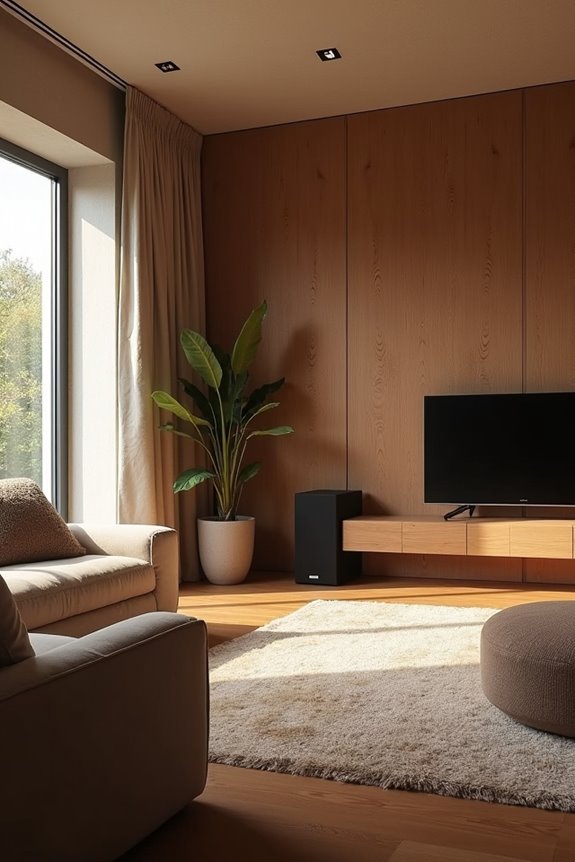
After you’ve settled on a general placement strategy, the room’s physical layout itself becomes your next consideration. Positioning your subwoofer away from parallel walls creates smoother bass response across your listening positions. Parallel walls generate standing waves and bass cancellations that define problem areas in room acoustics.
Non-parallel walls diffuse reflections differently, minimizing bass coloration and hotspots caused by room modes. Even shifting your sub a few inches off parallel planes noticeably improves bass balance. The subwoofer does this because it disrupts the predictable reflection patterns between opposite boundaries.
In rooms with multiple parallel surfaces, place your sub so its nearest wall isn’t parallel to the opposite boundary. This placement promotes uniform bass distribution. Your listening positions benefit because room modes affect fewer areas simultaneously.
Double Your Subwoofers to Fill Bass Gaps
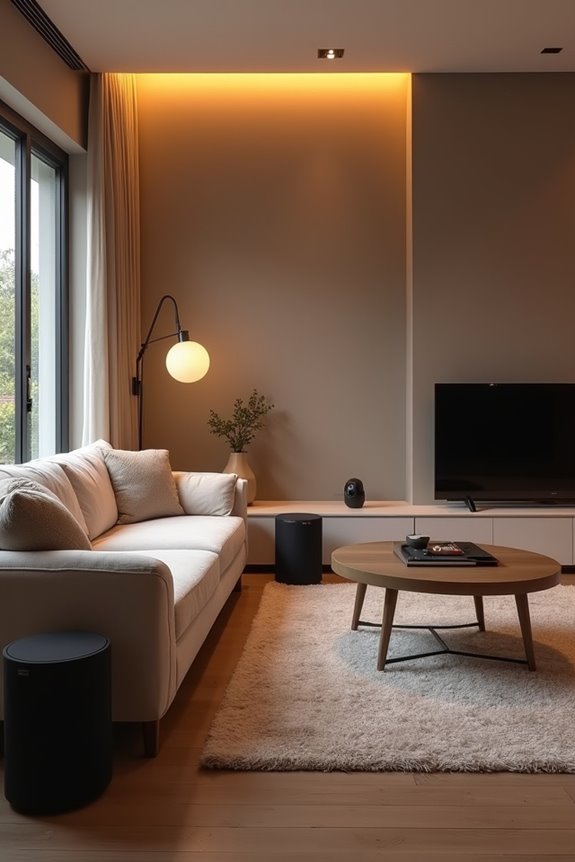
Why settle for one subwoofer when two creates dramatically smoother bass throughout your living room? A two-sub setup dramatically reduces standing waves and bass gaps that plague single-sub installations. You’ll achieve more even bass distribution by placing subwoofers in diagonally opposite corners or near front-wall placements with independent distances and phase settings. Two subwoofers lower the required output per unit, increasing headroom without overdriving either one. The room placement becomes less critical because dual subs average interactions across seating positions. Your calibration software becomes more effective too, reducing extensive manual tweaking. This arrangement creates tighter, more uniform bass response across multiple seats. The bass distribution improves because dual units render your room less sensitive to where you sit.