

Most cats won’t jump from your balcony, but prey like birds or sudden startle can override their natural caution. When hunting focus narrows their awareness, they misjudge distances and leap without considering height. Even with a righting reflex that lands them on their feet, falls from two to four stories cause severe injuries—broken bones, internal damage, and punctured lungs. Your balcony creates genuine danger when supervision lapses. Understanding what triggers these jumps defines your protection strategy.
Will Your Cat Actually Jump Off a Balcony?
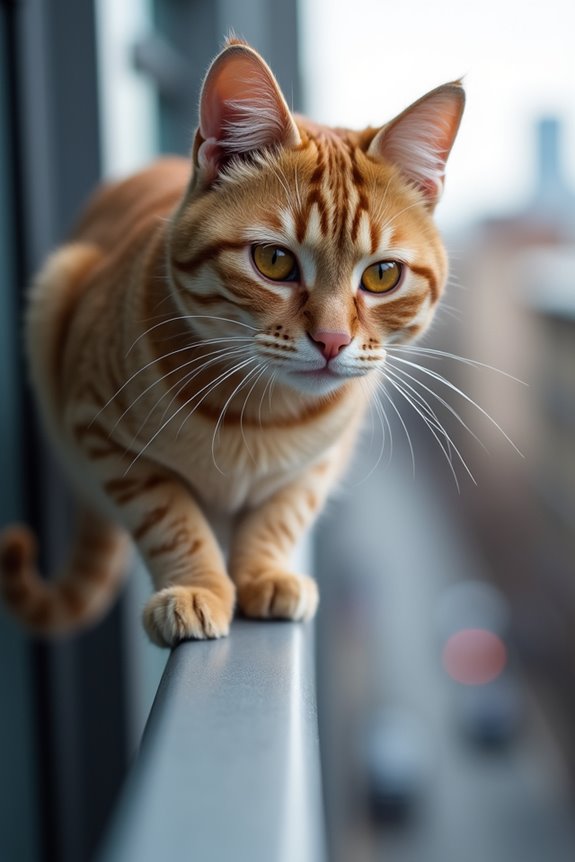
Do cats willingly leap from balconies? Most won’t. However, many exceptions exist that create genuine danger for your pet. Your cat’s instincts don’t account for high-rise syndrome—the injuries that result from falls at dangerous heights.
Most cats won’t leap from balconies, but exceptions exist—and high-rise syndrome creates genuine danger for your pet.
Chasing birds, sudden startlement, or focused prey attention can override your cat’s natural caution. Play near edges presents similar risks. Your cat does misjudge distances because predatory focus narrows their awareness of surroundings.
Even graceful landings don’t guarantee safety. Falls from balconies cause broken bones, internal injuries, and punctured lungs. The higher your balcony, the greater the injury risk. Distraction and sudden movements define dangerous scenarios.
Your responsibility includes recognizing that balcony access without supervision creates preventable harm. Secure barriers, protective netting, or harnesses define safer balcony use for your cat.
Why Balconies Are Irresistible (and Dangerous) to Cats

Your cat’s natural climbing instincts drive them toward balconies because elevated spaces offer vantage points for observing and stalking prey. These heights create danger, however, since agility alone doesn’t prevent falls when your cat chases birds, gets startled, or miscalculates during play. You’ll need to recognize that balcony hazards—from sudden distractions to unexpected slips—demand active prevention through barriers, supervision, and restraints.
Natural Climbing Instincts
Why do cats find balconies so appealing? Your cat’s natural climbing instincts drive this behavior. Cats descend from wild ancestors who sought tall trees for survival, and your pet retains these inherited urges today.
Your cat’s balance and agility make heights feel safe. The railing does nothing to discourage exploration because your cat perceives it as an inviting perch. Ledges and railings attract your cat through new textures, scents, and airflow that trigger investigation.
However, this instinct creates genuine danger. Your cat’s excellent balance doesn’t guarantee safety when distracted by prey or sudden noises. The righting reflex—your cat’s ability to land on its feet—fails during unexpected movements or falls from certain angles. Understanding this gap between instinct and actual safety defines responsible balcony management for cat owners.
Hidden Balcony Dangers
What makes a simple outdoor space dangerous? Your cat’s natural instincts. The balcony attracts your cat because it offers height, views, and hunting opportunities. These features create irresistible appeal that overrides caution.
High-rise syndrome describes injuries cats sustain from falls, even small ones. Your cat can misjudge distances or lose footing on smooth surfaces. A sudden bird or noise startles them unexpectedly. Missteps happen quickly, defining balcony dangers most owners underestimate.
Falls from modest heights cause broken limbs, facial injuries, and internal damage. Your cat’s agility doesn’t guarantee safety on elevated spaces. Concrete or pavement below amplifies injury risk significantly.
You’ll need barriers, netting, or supervision to protect your cat. Prevention addresses these hidden dangers before accidents occur. Your balcony requires safeguards that acknowledge your cat’s instinctual behavior.
High Rise Syndrome and Balcony Falls: Causes and Survival Rates
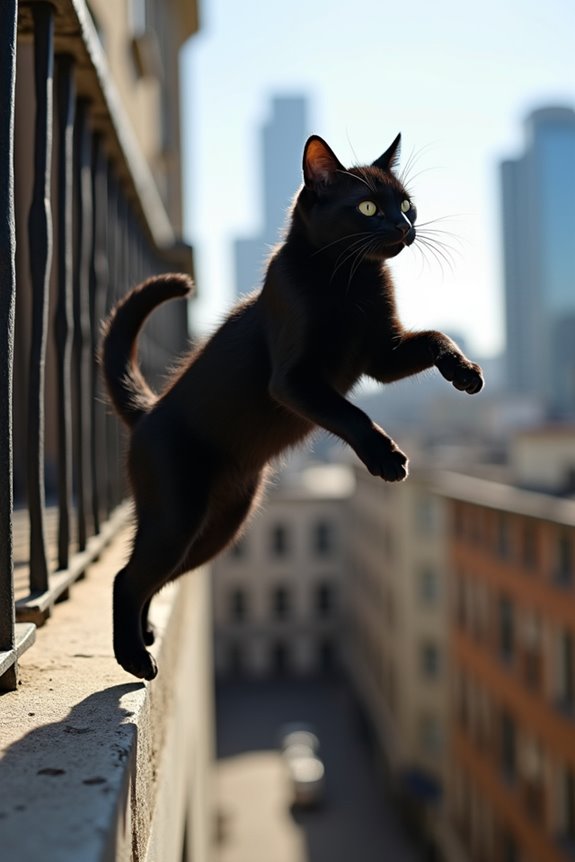
High-rise syndrome, the term veterinarians use for injuries sustained from falls at considerable heights, creates serious risks for cats living in multi-story buildings. Falls from two to four stories often cause more damage than shorter falls. Your cat’s body has limited time to adjust position during descent.
| Fall Height | Common Injuries | Survival Rate |
|---|---|---|
| 2-4 stories | Broken limbs, internal damage | 90% with care |
| Higher floors | Severe trauma, punctured lungs | Lower outcomes |
| Any height | Facial trauma, broken teeth | Varies |
A New York veterinary study tracked 132 cats with high-rise injuries. About 90% survived with appropriate veterinary treatment. Cats may appear uninjured initially. Internal injuries or delayed symptoms develop later, making prompt veterinary evaluation necessary for your cat’s recovery and long-term health.
Common Injuries Cats Sustain From Balcony Falls
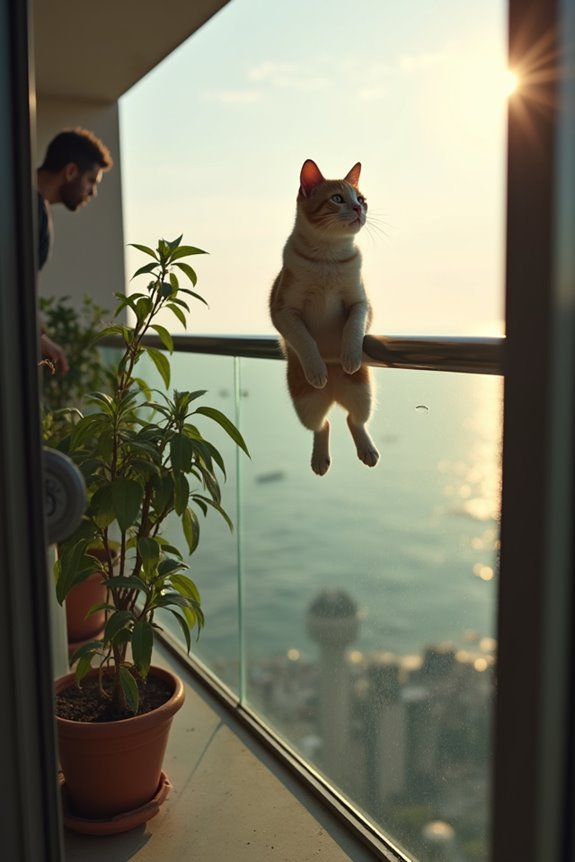
When your cat falls from a balcony, you’re looking at injuries across three main categories that require immediate attention. Limb and skeletal damage occurs because cats can’t always land perfectly, creating fractures in legs or the spine that define recovery time and mobility. Internal organ injuries and facial trauma—including dental damage—happen because the force of impact travels through your cat’s body, and these hidden injuries often need veterinary imaging to detect.
Limb And Skeletal Injuries
Skeletal injuries dominate the injury profile when cats fall from balconies, creating serious complications that demand immediate veterinary attention. Your cat’s balance and ability to land properly diminish during falls, resulting in broken or sprained limbs from impact and awkward positioning. The injuries you’ll notice include limping, reluctance to bear weight, or changes in how your cat uses affected legs.
Facial and jaw injuries frequently accompany limb damage, compounding the trauma. Even from high-rise falls where air trajectory slows descent slightly, your cat faces significant leg or pelvic fractures. The limited time to reorient mid-fall defines why these injuries occur so predictably.
You must seek prompt veterinary assessment immediately after any balcony fall. Internal injuries often hide alongside skeletal trauma, requiring diagnostic imaging to reveal what’s not immediately visible.
Internal Organ Damage
Beyond the visible breaks and bruises, what happens inside your cat’s body during a balcony fall often proves more dangerous than external injuries. Internal injuries from balcony falls create serious health complications that you won’t immediately see.
| Injury Type | Symptoms | Timeline |
|---|---|---|
| Punctured lung | Rapid breathing, letharness | Hours to days |
| Ruptured bladder | Abdominal pain, vomiting | 24-48 hours |
| Organ damage | Loss of appetite, restlessness | Days to weeks |
Your cat may appear fine after falling, yet internal damage progresses silently. The impact creates trauma inside organs that requires immediate veterinary evaluation. Quick assessment defines your cat’s survival chances significantly.
Watch for warning signs: vomiting, appetite loss, abdominal tenderness, or unusual breathing patterns. These symptoms indicate internal injuries need urgent treatment. Seek veterinary care promptly after any balcony fall, regardless of how your cat seems outwardly.
Facial And Dental Trauma
How often do cat owners miss mouth injuries after a balcony fall? Facial trauma and dental injuries occur frequently in high-rise incidents, yet many owners overlook these hidden wounds. Your cat’s righting reflex doesn’t always prevent tooth damage, especially during two-to-four story drops where reorientation time remains limited.
Broken teeth, jaw injuries, and facial abrasions define common fall outcomes. The impact creates conditions requiring veterinary dentistry or surgical repair. Even cats appearing uninjured may harbor persistent oral damage that worsens without assessment.
Post-fall care demands prompt veterinary evaluation. Your vet checks for dental damage, oral bleeding, and punctured lips alongside other injuries. This thorough approach identifies problems before they develop into serious complications. Assume your cat needs professional examination—veterinary assessment protects their long-term health.
Why the Righting Reflex Doesn’t Prevent Balcony Injuries
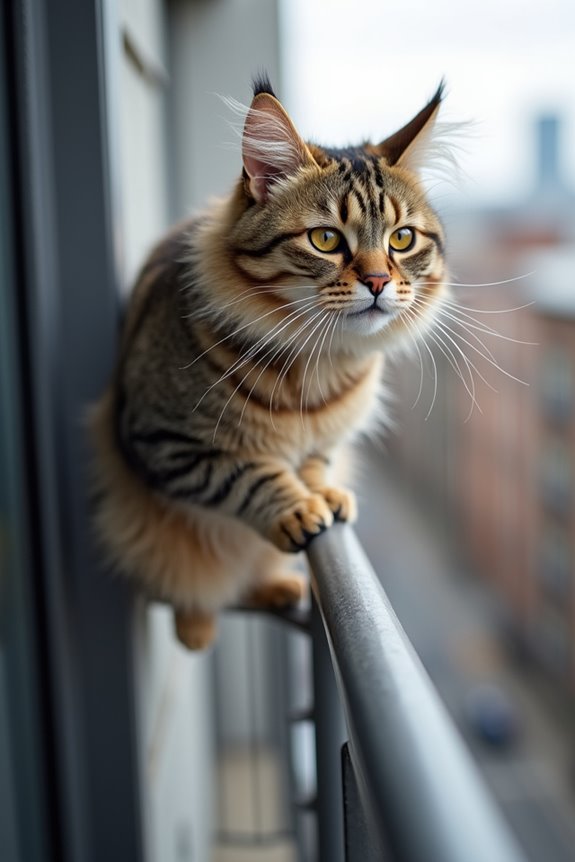
Many cat owners believe the righting reflex—the cat’s instinctive ability to flip mid-air and land on its front feet first—provides complete protection during falls. This assumption creates a false sense of security regarding balcony safety.
The righting reflex has significant limitations. Your cat needs sufficient height and time to reorient its body properly. Falls from two to four stories often cause severe injuries despite this reflex working correctly. The cat does land on its front feet because of this instinct, but the impact force overwhelms protective capabilities.
Short-height balcony falls present particular dangers. Your cat may not have enough distance to adjust position before hitting hard surfaces or edges. This explains why the righting reflex alone cannot prevent injuries. You must implement preventative balcony safety measures regardless of your cat’s natural abilities.
What Actually Causes Cats to Fall: Distractions, Startlement, and Misjudgment
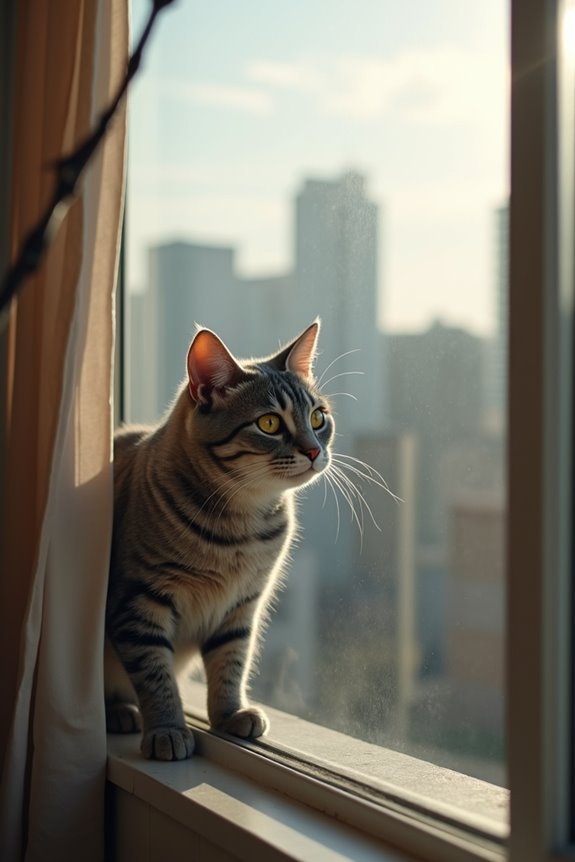
Your cat doesn’t intentionally jump off a balcony; instead, accidents happen when prey or other distractions pull their focus away from safe footing. A sudden noise or movement can startle your cat so completely that they lose their balance on a railing or ledge, creating a dangerous fall situation. When your cat misjudges the distance to a perch or fails to account for a narrow edge, their confidence in jumping doesn’t guarantee they’ll land safely.
Prey Pursuit and Distraction
What really causes cats to fall isn’t clumsiness—it’s distraction. Your cat’s prey drive creates dangerous situations on balconies. A bird landing on the ledge triggers immediate focus, causing your cat to misjudge the jump distance. This distraction defines the moment between safety and risk.
| Distraction Type | Risk Level | Common Trigger | Prevention |
|---|---|---|---|
| Bird sighting | High | Visible movement | Install screens |
| Small creature | High | Rustling sounds | Secure railings |
| Sudden noise | Medium | Startlement | Reduce access |
| Playful impulse | Medium | Own excitement | Supervise time |
Prey pursuit overrides your cat’s natural caution. Your cat doesn’t calculate consequences when chasing visible movement. The balcony becomes a hunting ground rather than a safe space. Understanding this instinct helps you create protective barriers that prevent tragic falls.
Startle Responses and Balance Loss
Sudden noises and unexpected movements create split-second reactions that override your cat’s careful footing. When you approach the balcony door or a loud sound startles your cat, their body tenses. This startle response defines a critical moment where balance loss becomes likely.
Your cat’s instinct kicks in immediately, triggering rapid movement toward unfamiliar territory. The balcony edge becomes dangerously close during this disorientation. Even cats with excellent balance struggle when their focus shifts suddenly.
The metal railing does little to prevent falls because your cat may leap away from the perceived threat rather than toward safety. Startle responses override your cat’s natural caution. During these moments, your cat’s coordination falters significantly. Understanding this vulnerability helps you recognize why sudden disturbances create genuine fall risks on elevated outdoor spaces.
Misjudging Distances and Ledges
How often do you notice your cat’s eyes fixed on a bird outside the balcony railing?
Your cat’s natural hunting instincts create situations where misjudging distances becomes dangerous. Even skilled climbers miscalculate spacing between themselves and the edge. Consider these common scenarios:
- Chasing prey causes your cat to lose spatial awareness
- Sudden movements trigger quick, unplanned lurches toward edges
- Distractions like toys shift focus from balcony safety
- Nearby noises startle your cat into hasty reactions
- Experienced climbers still misjudge step distances
The ledge does become a hazard because your cat’s attention narrows during excitement. Falls happen not from poor balance, but from miscalculating where the edge actually is. You’ll notice your cat’s ears forward, body tensed, completely focused on the target below. This tunnel vision defines why balcony safety requires your intervention through barriers and supervision.
How to Assess Your Balcony’s Risk Level for Your Cat?
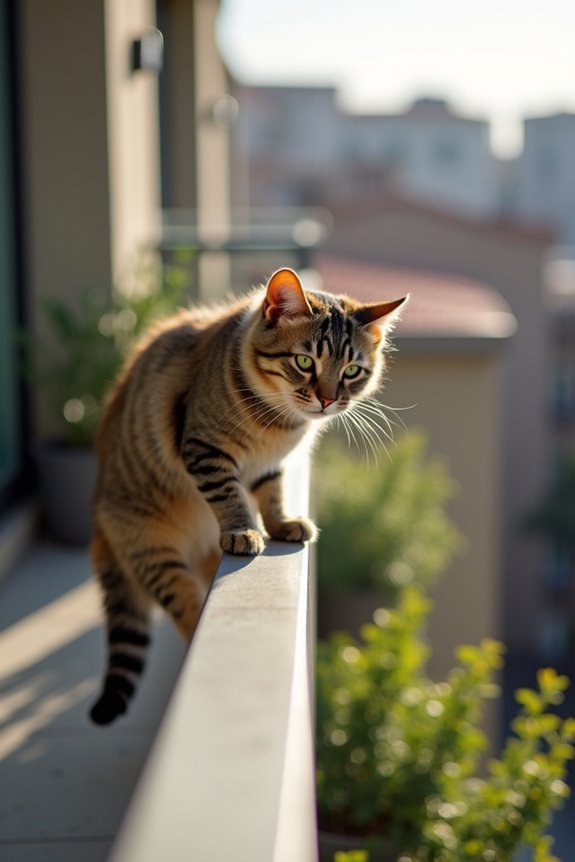
Your balcony’s safety depends on three interconnected factors: its physical barriers, your supervision habits, and your cat’s escape routes.
First, examine your barriers closely. Gaps wider than two inches between railings create high-rise syndrome risks. Secure netting prevents jumps entirely. The netting works because it blocks your cat’s access to ledges.
Next, assess supervision honestly. Constant caregiver presence defines safer environments. You can’t watch your cat every moment outdoors, so plan accordingly.
Finally, evaluate escape routes inside. Your cat needs clear access back indoors without jumping or climbing obstacles. The door placement matters because it determines whether your cat can retreat safely.
Document these three elements. This assessment creates a realistic picture of your balcony’s actual danger level, guiding which protective measures you’ll implement next.
Balcony Fencing and Netting: Creating Safe Outdoor Access

What separates a risky balcony from a secure outdoor space? The right barriers and safety netting create a contained environment where your cat can enjoy fresh air without falling risk.
You’ll find several effective options:
- Chicken wire or metal mesh creates an affordable enclosure that prevents escape attempts
- Glass panels maintain clear sightlines while defining a solid protective boundary
- Custom safety netting withstands cat jumping force and weather exposure reliably
- Metal bars offer permanent security when landlord approval exists for installation
- Temporary fencing solutions work for renters, requiring only permission and no structural changes
Proper installation covers your entire balcony perimeter without gaps. The netting works because cats cannot squeeze through or scale completely enclosed designs. Regular maintenance preserves structural integrity against wear and weather damage.
Train Your Cat to Walk on Harness Before Balcony Time
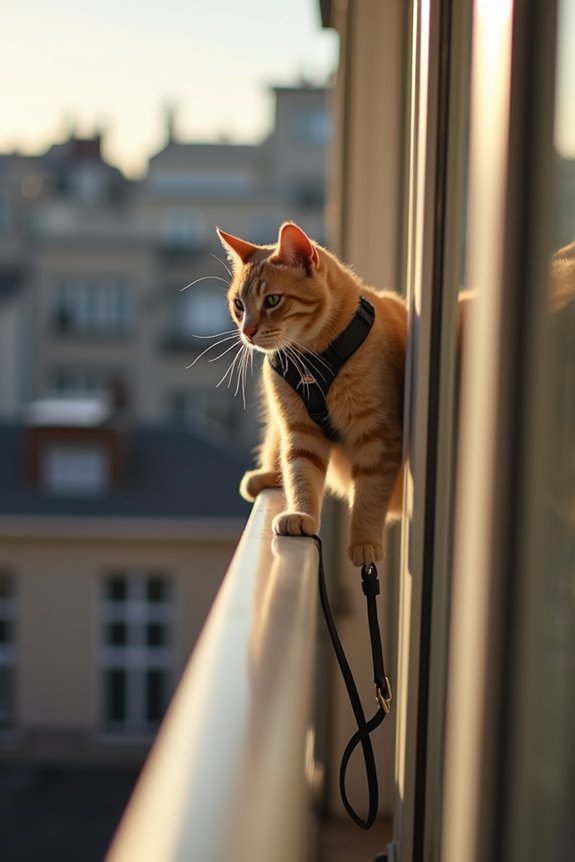
Before your cat sets foot on the balcony, harness training creates a necessary safety foundation. You’ll start with short indoor sessions using a well-fitted harness and lightweight leash. This approach builds your cat’s confidence gradually while establishing trust between you both.
Pair each training session with treats and praise. Your cat responds positively to rewards, which reinforces desired behavior. Practice in low-stress areas away from balcony edges initially. The quiet space does reduce anxiety because your cat isn’t overwhelmed by new surroundings.
Gradually increase time and exposure to balcony surroundings as your cat adjusts. Monitor closely for stress signals like excessive pulling or hiding. Discontinue training if persistent fear emerges. Proper harness training defines responsible balcony safety, protecting your cat from dangerous edge encounters and falls.
What to Do Immediately After Your Cat Falls

If your cat falls, seek immediate veterinary care—even without visible injuries. Watch for hidden damage by monitoring for limping, disorientation, or nose bleeding, as these signs may appear after the incident. Observe your cat closely over the next 3–4 hours for head injury symptoms like confusion, vomiting, or unsteady movement, and contact an emergency veterinarian if any develop.
Immediate Veterinary Care
Your cat’s survival after a fall depends heavily on how quickly you act. Immediate veterinary care produces the best outcome for your cat’s recovery and health.
Take your cat to the vet right away by:
- Calling ahead so the clinic prepares for your arrival and prioritizes your cat
- Transporting carefully in a secure carrier to prevent additional injuries during the drive
- Reporting observations including bleeding, limping, breathing changes, or unresponsiveness to your veterinarian
- Mentioning the fall height and landing surface, which helps your vet assess internal injury risk
- Following up within 3–4 hours to monitor for delayed concussion signs like disorientation or vomiting
The prompt medical evaluation does what external observation cannot—it reveals internal injuries invisible to your eye. Your vet’s examination determines whether your cat needs treatment. Professional assessment prevents serious complications from developing undetected.
Assess For Hidden Injuries
While getting your cat to the vet remains your priority, the hours immediately after a fall demand careful observation at home. You’ll monitor for signs that indicate a hidden injury requires urgent attention. The following warning signs create cause for immediate action:
| Warning Sign | What It Means |
|---|---|
| Disorientation or confusion | Possible head injury |
| Unsteady gait or stumbling | Neurological damage |
| Vomiting or drooling | Internal injury present |
| Unusual pupil movements | Head injury indicator |
| Bleeding from nose or mouth | Internal trauma likely |
You’ll also watch for limping, changes in appetite, and abnormal breathing patterns that emerge hours after the fall. These symptoms define injuries that aren’t immediately visible. Your calm, restricted environment limits movement and prevents further damage while you arrange veterinary evaluation. Schedule a same-day check to identify concealed injuries early, improving treatment outcomes significantly.
Monitor Post-Fall Symptoms
What happens in the first hours after your cat falls defines whether hidden injuries get caught early. Your cat’s post-fall symptoms reveal important information about internal damage that isn’t immediately visible.
Monitor these key areas:
- Limb use: Watch if your cat landed feet-first but now limps or favors one leg
- Breathing patterns: Note any labored or shallow breathing that develops gradually
- Eating and drinking: Track whether your cat refuses food or water within hours
- Balance and coordination: Observe unsteady gait, disorientation, or pawing at the head
- Energy levels: Document unusual lethargy, restlessness, or excessive sleepiness
Set a re-check alarm for three to four hours post-fall. This timing creates an important window for spotting delayed post-fall symptoms. Pale gums, repeated vomiting, weakness, or new neurological signs demand immediate emergency veterinary care. Early observation prevents serious complications from progressing undetected.
Signs of Internal Injury and When to Seek Emergency Care
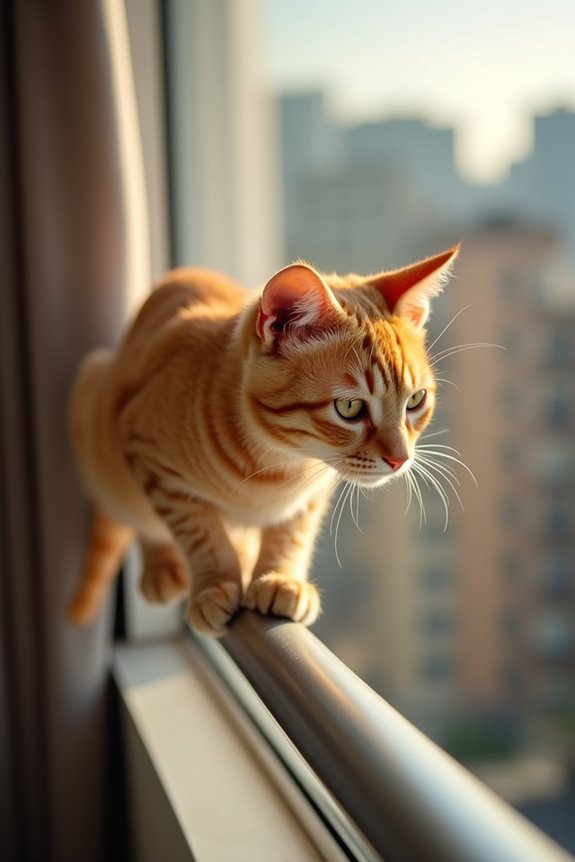
How quickly internal injuries develop after a balcony fall often determines whether your cat survives the incident. You must watch for specific warning signs that indicate hidden damage. Vomiting, disorientation, unsteady gait, rapid breathing, and pale or blue-tinged gums all suggest internal injury requiring immediate emergency care.
Your cat’s appearance can deceive you. Even without visible wounds, punctured lungs, ruptured bladder, or organ damage may exist internally. These injuries aren’t always obvious at first.
Seek emergency care immediately if you notice labored breathing, collapse, persistent vomiting, or new neurological signs. Any behavior changes after the fall warrant professional evaluation. Prompt veterinary assessment produces the best outcome for your cat’s survival and recovery.
Getting Your Cat Moving Again (Safely)
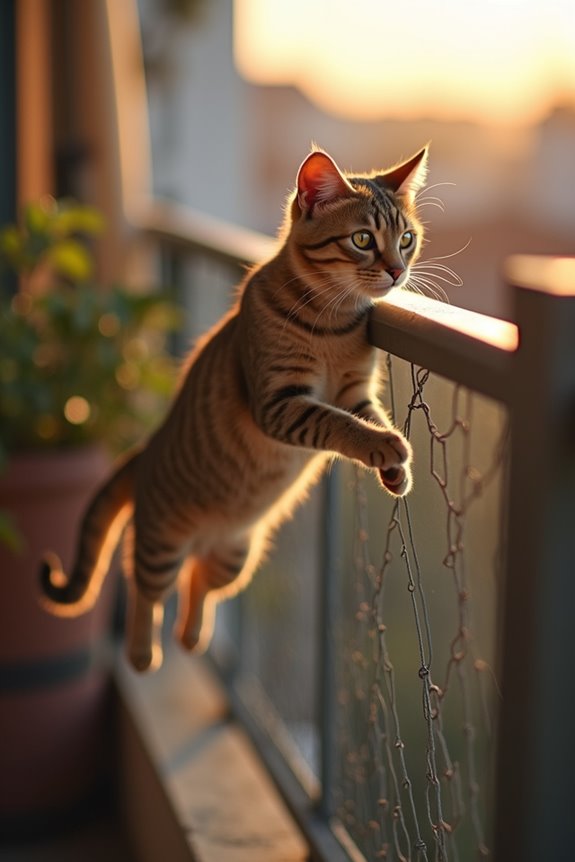
Once you’ve ruled out serious internal injuries, your cat needs gradual reintroduction to normal activity. Your cat’s recovery defines how safely they’ll move forward. Start with short indoor sessions before expanding outdoor exposure. This approach builds confidence without overwhelming your recovering pet.
Monitor your cat’s progress carefully:
- Watch for limping, disorientation, or pain signals beyond 24 hours
- Begin with brief movement sessions, then gradually increase duration
- Use a harness and leash during supervised balcony time after a fall
- Note improvements in balance and coordination over days to weeks
- Restrict unrestricted balcony access until your veterinarian clears it
Your cat’s movement patterns reveal their healing stage. Provide easy access to food, water, and rest areas. Limited handling reduces stress during recovery. The gradual activity plan works because it rebuilds your cat’s strength naturally, preventing high-risk situations from repeating.
Restoring Your Cat’s Mobility and Trust After Injury
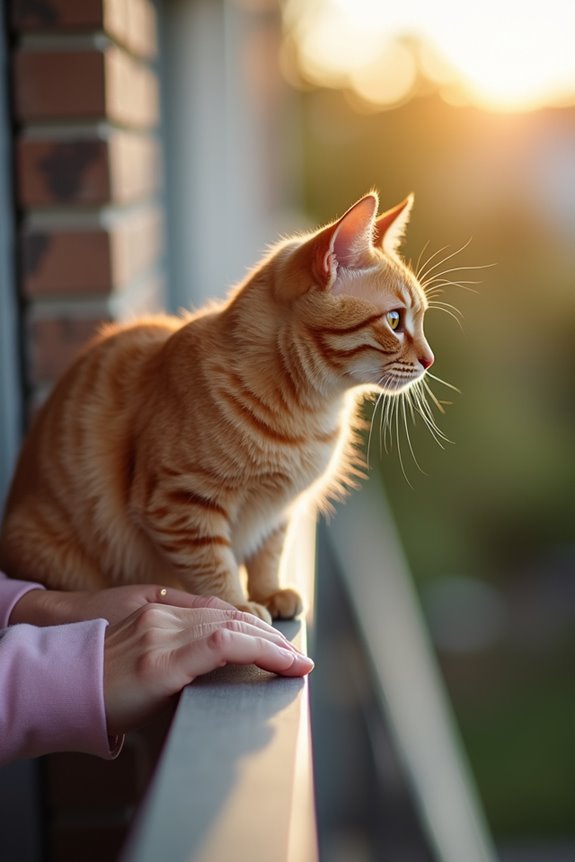
Your cat’s recovery depends on creating an environment that supports both physical healing and emotional confidence. Start with short, supervised movement sessions in a confined space. These sessions rebuild strength gradually without overwhelming your recovering pet.
The indoor setting does prevent high rise syndrome because it eliminates dangerous jumping opportunities. Keep furniture low and accessible, avoiding tall cat trees temporarily. Your cat needs safe routes between resting areas and litter boxes.
Gentle positive reinforcement during movement rebuilds trust after trauma. Praise small accomplishments when your cat walks steadily or lands on their feet without hesitation. Schedule follow-up wellness exams to monitor healing progress and pain levels.
Watch for limping, unsteady gait, or reluctance to move. These signs indicate you should contact your veterinarian before resuming normal activity levels.
Indoor Enrichment: A Safer Alternative to Balcony Time

As your cat regains strength and confidence indoors, satisfying their natural climbing instincts becomes the next priority. Indoor enrichment creates safe alternatives to cat balcony access while reducing the urge to explore dangerous outdoor spaces.
You can implement these proven strategies:
- Vertical toys and cat shelves mounted on walls replicate high vantage points without fall risks
- Puzzle feeders engage your cat’s problem-solving abilities during interactive play sessions
- Window perches positioned near natural light satisfy observational instincts safely
- Tall cat trees with multiple levels offer climbing opportunities throughout your home
- Rotating activities like feather wands and laser pointers prevent boredom
Interactive play sessions lasting 10–15 minutes, repeated two to three times daily, provide equivalent physical and mental engagement. The structured routine reduces stress-driven balcony desires through consistent scheduling and predictability. Environmental enrichment decreases accident likelihood while building trust between you and your recovering cat.
When Should You Consult Your Veterinarian About Balcony Access?
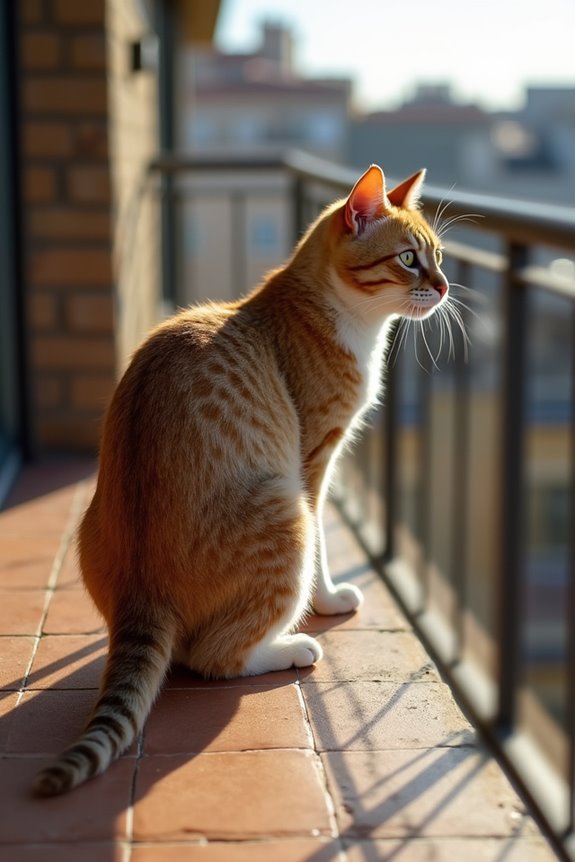
How do you know if your cat’s balcony time poses genuine health risks? You’ll want to schedule a wellness exam with your veterinarian to assess your cat’s balance, vision, and overall safety before allowing balcony access.
Your vet creates a personalized evaluation that defines whether balcony time suits your cat’s specific health status. Age, existing health issues, and medications all affect fall risk significantly. The assessment identifies hidden vulnerabilities you might miss.
If your cat shows risky balcony behavior or has previously experienced cat falls, professional guidance becomes necessary. Your veterinarian also develops a comprehensive balcony safety plan. Consider barriers, harness use, and supervised access arrangements together with your vet to provide appropriate protection for your cat’s wellbeing and longevity.